
Why tone of voice is harder than visuals, and more important to get right.
Tone of voice extends beyond the places your brand guidelines reach.
- Why words are harder to control than visuals.
- Your tone of voice turns up everywhere.
- The tricky bit: words don’t stay still.
- So who owns the tone of voice?
- It’s not just about writing well.
- Tone of voice is what makes people trust you.
- Consistency is where most brands fall down.
- Final word.

Why words are harder to control than visuals.
Ask most people to describe a brand, and they’ll talk about logos, colours or packaging. That’s what they notice first. But visual identity is only one part of how a brand presents itself, and it’s often the easiest part to keep consistent.
You create a brand style guide, you roll it out, and then every designer knows what to do. It’s much harder to do the same with language. Because while visuals are often produced by a handful of designers, words come from everyone.
Emails. Web copy. Social posts. Customer service replies. Even internal memos. These all carry your tone of voice, whether you want them to or not.
“Visuals can be controlled. Language can’t. That’s why tone of voice is the harder part of branding, and the most overlooked.”
Your tone of voice turns up everywhere.
Tone of voice isn’t something you turn on for campaigns and switch off again. It lives in all your communications, from the footer of your website to the way your CEO answers a Q&A.
That makes it far more visible, in practice, than your logo. A badly worded message will undermine even the most polished brand identity. Yet most companies still give tone of voice less attention than design.
“A consistent tone of voice builds trust. Without it, even the best design can’t carry your brand.”
The tricky bit: words don’t stay still.
Unlike a logo or set of icons, copy doesn’t just sit in one place.
- It evolves.
- It reacts.
- It gets rewritten.
New people get involved. Marketing says one thing. Sales say something else. HR posts a job ad that sounds like it’s from another company altogether.
Designers usually work within fixed templates. Writers don’t. That’s part of the challenge, and why a tone of voice needs more than a few adjectives in a brand book.
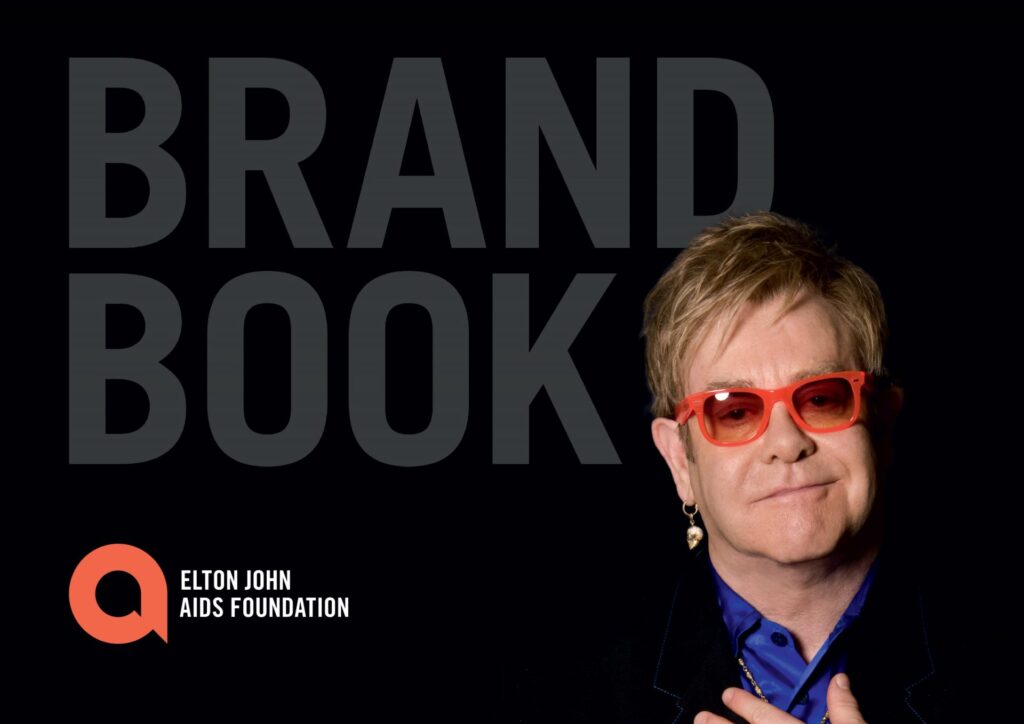
The Elton John AIDS Foundation Brand Book was designed to embody all aspects of the brand, including how it sounds.
So who owns the tone of voice?
With visual identity, there’s usually a clear process. A designer leads the work, signs off on the assets, and everyone refers to the brand guidelines. But when it comes to tone of voice, ownership often falls through the cracks.
- Is it marketing?
- Is it content?
- Is it everyone’s responsibility?
That vagueness is what leads to drift. Over time, different parts of the business adopt different tones. Eventually, the brand starts to sound inconsistent, or worse, invisible.
You need someone to own it. Not just create it and walk away, but maintain it, update it, and help others use it. Because, like a house, a tone of voice needs upkeep.
It’s not just about writing well.
Good tone of voice work isn’t about using perfect grammar or clever copy. It’s about sounding human. Reliable. Recognisable. Whether you’re writing a brochure, a push notification, or a holding message when your site goes down.
This is where many brands get stuck. They assume tone of voice means “friendly and casual”. But tone doesn’t mean bland. It means deliberate. You might be sharp and provocative. You might be formal and precise. What matters is that it’s clear, repeatable and distinct from your competitors.
Tone of voice is what makes people trust you.
Tone of voice plays a huge part in how much people trust your brand. You can’t fake that with a visual identity alone. You need language that aligns with your values and a tone that aligns with your audience.
We all know what it feels like when the tone is off. A cold auto-response from a warm brand. A chirpy message when someone’s reporting a problem. It’s not just jarring; it damages credibility.
Tone shows customers that you understand them. And that you’re consistent in how you think, act and respond.
Consistency is where most brands fall down.
The real test of tone of voice isn’t how clever your copy is. It’s how consistent it is across every part of the business. That’s where most brands fall short. Especially if there’s been no training, no shared examples, and no one encouraging people to use it.
- You can’t assume that everyone in the company will ‘get it’.
- You have to show them.
- You need examples, guidelines, prompts and workshops.
- You need to make it easy for teams to use the voice and make it their own, without going off track.
We’ve seen great tone-of-voice work die within a year because no one was responsible for keeping it alive.
“Every team member writes. That’s why tone of voice is harder to manage than a visual identity handled by a design team.”

On Call Africa’s Brand Guidelines provide essential guidance on communicating brand consistency across all applications.
Final word.
Tone of voice is harder than visual identity for one simple reason: everyone writes. Not everyone designs. And if you don’t guide how people write, your brand voice will end up pulled in a dozen directions.
If your tone of voice is going to mean anything, it needs to be clear, owned, supported and embedded into the business. Otherwise, it becomes a missed opportunity, one that will cost you more in the long run than a mismatched font ever could.

Written by: Simon
Simon heads up Games & Theory at Toast. He helps people solve problems. From naming and positioning through to conversion and retainment, Simon helps our branding clients grow their businesses.